

Introduction: Why Traditional Deburring Always Faces Limits
For decades, manufacturers believed burr removal was purely a mechanical challenge. The common logic was simple: if a burr appears, a stronger grinding force or a finer polishing wheel should solve the problem. This idea led to the widespread use of grinding wheels, abrasive belts, buffer systems, and various polishing machines across the metal processing industry.
However, modern precision manufacturing has changed the rules completely.
Today's components are no longer simple flat metal parts. Aerospace structures, medical implants, semiconductor components, and precision automotive parts often contain micro-holes, intersecting channels, deep grooves, and extremely delicate edges. In these structures, traditional metal polishing machines face serious limitations. Large polishing heads cannot reach hidden areas, while excessive mechanical contact can easily deform critical surfaces.
This is why plasma polishing technology has become one of the most discussed innovations in advanced surface finishing.
Unlike a traditional polishing machine for metal, plasma polishing does not rely on direct physical grinding. Instead, it uses controlled electrical energy, electrolyte reactions, and plasma discharge behavior to reshape the metal surface at a microscopic level. The remarkable part is not just the polishing speed — it is the process intelligence hidden inside the physics itself.
One of the most fascinating characteristics of a plasma polishing machine is that it can automatically “find” burrs before attacking the rest of the surface. No robotic path programming is required. No visual positioning system is needed. Even highly complicated parts can experience selective deburring naturally.
This almost makes plasma polish appear “smart,” but the reality is even more interesting: the process is governed by energy distribution laws rather than software commands.
In other words, the burr removes itself because physics forces the system to prioritize it.
That is the true reason why many modern polishing machine manufacturers are shifting their research toward plasma systems. Instead of forcing the machine to imitate human polishing behavior, engineers are designing systems where the metal surface participates in the polishing logic itself.
This represents a major transition in industrial finishing philosophy:
Traditional polishing removes material everywhere.
Plasma polishing removes material where energy naturally concentrates first.
As manufacturing tolerances continue shrinking, this selective finishing capability is becoming far more valuable than brute polishing force. This is especially true for high-end industries that demand micron-level consistency, repeatability, and minimal dimensional damage.
Today, many china polishing machine suppliers are rapidly investing in intelligent plasma polishing machine development because the future of deburring is no longer about harder grinding — it is about smarter energy control.
Plasma Polishing Is Not “Grinding” — It Is Intelligent Energy Redistribution
Most people imagine polishing as a process of physical friction. A wheel touches metal, abrasive particles cut microscopic peaks, and the surface gradually becomes smooth. Traditional polisher buffer machine systems are essentially controlled scratching tools.
Plasma polishing completely breaks this manufacturing logic.
A plasma polishing machine does not “rub away” burrs in the traditional sense. Instead, it creates an energetic environment where the metal surface reorganizes itself according to electrical field behavior. The process looks less like grinding and more like intelligent energy redistribution.
This is why plasma polishing technology often produces results that appear impossible for conventional polishing machines.
Inside the electrolyte, the workpiece becomes part of an electrical system. Every contour, corner, burr, and microscopic protrusion influences how energy flows across the surface. Unlike mechanical polishing, where pressure depends on tool contact, plasma polish depends on how electrical energy naturally chooses its path.
This changes everything.
Instead of forcing a polishing head into tiny areas, the energy itself travels toward the most reactive regions automatically. Burrs, sharp edges, and unstable micro-peaks become energy “magnets.” Flat surfaces become low-priority zones.
In traditional metal polishing machines, engineers try to control polishing behavior externally through pressure, speed, angle, and abrasive selection. In plasma systems, the surface geometry internally controls the reaction behavior.
The workpiece itself becomes the processing guide.
This is one reason why advanced polishing machine manufacturers increasingly describe plasma polishing as a “self-adaptive finishing process.” The machine supplies energy, but the metal surface determines where that energy becomes most aggressive.
The result is highly selective finishing that feels almost biological rather than mechanical.
Instead of attacking the entire component equally, the plasma environment continuously searches for energetic imbalance. Wherever the geometry creates concentrated electrical stress, the reaction intensifies automatically.
That means:
● Sharp burrs disappear first
● Microscopic spikes smooth first
● Unstable edges round first
● Hidden roughness levels itself first
This is fundamentally different from conventional polishing machine china systems based on direct contact abrasion.
The brilliance of plasma polishing is not simply speed.
Its real power is selective intelligence created by physics itself.
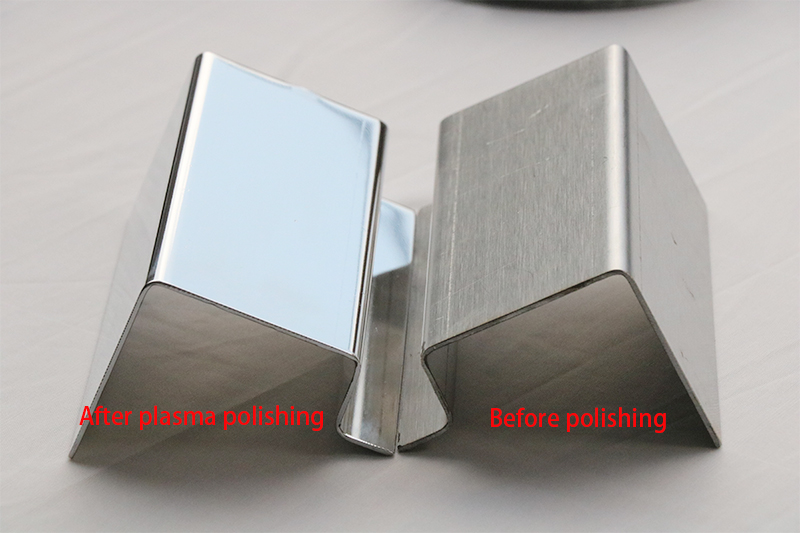
Why Burrs Become the First Target in Plasma Polishing
If plasma polishing had a “secret,” it would be this:
Electricity hates uniformity.
Whenever an electrical field encounters sharp geometry, the energy naturally compresses toward that location. This phenomenon is not unique to plasma polishing technology — it exists everywhere in physics, from lightning rods to semiconductor chips.
In plasma polishing, burrs unintentionally behave like microscopic lightning rods.
Their sharp tips create extremely concentrated electric field lines. Compared with flat surfaces, the local current density at a burr can become dramatically higher. The sharper the geometry, the stronger the energy concentration becomes.
This is the real reason why a plasma polishing machine automatically prioritizes burr removal.
The process does not need cameras or AI recognition.
Physics already identifies the burr for the machine.
Once current density rises at the burr tip, several reactions accelerate simultaneously:
● Metal dissolution speeds up
● Localized heating intensifies
● Plasma discharge becomes more active
● Surface instability increases rapidly
Meanwhile, flat regions experience much weaker reactions because the electrical field spreads evenly across larger areas.
This creates a natural hierarchy of removal:
The sharper the feature, the faster it disappears.
Traditional polishing machines struggle because they apply force broadly. A grinding wheel cannot easily distinguish between a burr and a precision edge. Excessive polishing often damages the entire geometry.
Plasma polishing technology behaves differently because energy localization happens automatically at the microscopic level.
In many cases, the burr removal speed can become several times faster than the removal rate of the surrounding surface. This selective effect allows plasma polishing machine systems to remove defects while preserving dimensional integrity.
Even more importantly, this process works regardless of complexity.
Tiny holes, intersecting channels, hidden cavities, and internal corners all obey the same electrical laws. Wherever sharp energy concentration exists, plasma reactions naturally intensify.
That is why modern polishing machine manufacturers increasingly view plasma systems as “geometry-responsive finishing technology.”
The machine does not need to know where the burr is.
The burr reveals itself through energy behavior.
The Invisible Vapor Layer That Protects Flat Surfaces
One of the most misunderstood aspects of plasma polishing is that the process is not purely electrical. Thermal dynamics also play a major role.
As current flows through the electrolyte, localized heat rapidly forms around the workpiece surface. This heat generates a microscopic vapor layer composed of gas bubbles, vaporized electrolyte, and plasma-active zones.
This thin layer behaves like an invisible processing membrane.
In many ways, the vapor film acts as a natural regulator inside the plasma polishing machine. It controls where electrical discharge becomes strong and where reactions become suppressed.
But the fascinating part is this:
The vapor layer does not form uniformly.
Flat surfaces tend to develop thicker and more stable gas films. These films create partial insulation, reducing discharge intensity and slowing metal dissolution.
Sharp burrs behave completely differently.
At protruding tips, the vapor layer becomes unstable and extremely thin. The concentrated electric field repeatedly breaks through the gas barrier, allowing stronger plasma discharge and higher localized reaction intensity.
This creates a remarkable self-balancing mechanism:
● Flat surfaces become naturally protected
● Burrs become naturally exposed
● Sharp corners receive stronger discharge
● Stable geometry receives weaker attack
This is why plasma polishing technology can create smooth surfaces without aggressively destroying the overall shape.
Traditional buffer polisher machine systems depend entirely on mechanical pressure control. If pressure increases too much, the whole surface suffers. Plasma systems instead rely on energetic selectivity.
The process resembles intelligent editing rather than aggressive cutting.
Another important advantage is consistency.
Because vapor layer behavior follows physical laws, every part inside the same electrolyte tank experiences similar selective reactions. This is why modern polishing machine manufacturers often use plasma systems for high-volume precision production.
Instead of depending heavily on operator skill, the process stabilizes itself naturally.
This is one reason why advanced China polishing machine suppliers are increasingly focusing on automated plasma polishing machine solutions for aerospace, medical, and semiconductor industries.
The vapor layer is not just a side effect.
It is one of the hidden reasons why plasma polishing can “protect the good while removing the bad.”
Because of the limited length of this article, more details will be covered in the next article.