

1. Introduction: A New Perspective on Surface Engineering
In modern manufacturing, surface quality is no longer just about aesthetics—it directly determines performance, durability, and even safety. From aerospace components to medical implants, the microscopic condition of a surface can define whether a product succeeds or fails.
This is where plasma polishing technology emerges as a game-changing solution. Unlike traditional methods that rely on mechanical force or aggressive chemicals, plasma polishing introduces a controlled, energy-driven interaction between material and ionized gas.
What makes this process truly unique is not just its ability to smooth surfaces—but its capability to re-engineer the surface structure itself, both visibly and invisibly.
For manufacturers working with high-precision components, choosing the right plasma polishing machine is no longer optional—it’s becoming a competitive necessity.
In this article, we will explore how plasma polishing transforms material surfaces at multiple levels—from microstructure refinement to macro-geometry optimization—and why leading polishing machine manufacturers are investing heavily in this technology.
2. What Is Plasma Polishing? Beyond Traditional Finishing
At its core, plasma polishing is a surface-finishing process that uses ionized gas (plasma) to remove material in an extremely controlled and uniform manner.
Inside a plasma polishing machine, electrical energy excites gas molecules into a plasma state. These high-energy particles interact with the material surface, causing microscopic peaks to dissolve faster than valleys.
This selective removal mechanism leads to an inherently self-leveling effect—something traditional polishing methods struggle to achieve.
Compared to mechanical polishing:
● No abrasive contact
● No induced stress
● No secondary damage
● Compared to chemical polishing:
● More controllable
● Environmentally friendly
This is why many advanced polishing machine factories are shifting toward plasma-based systems as the next-generation finishing solution.
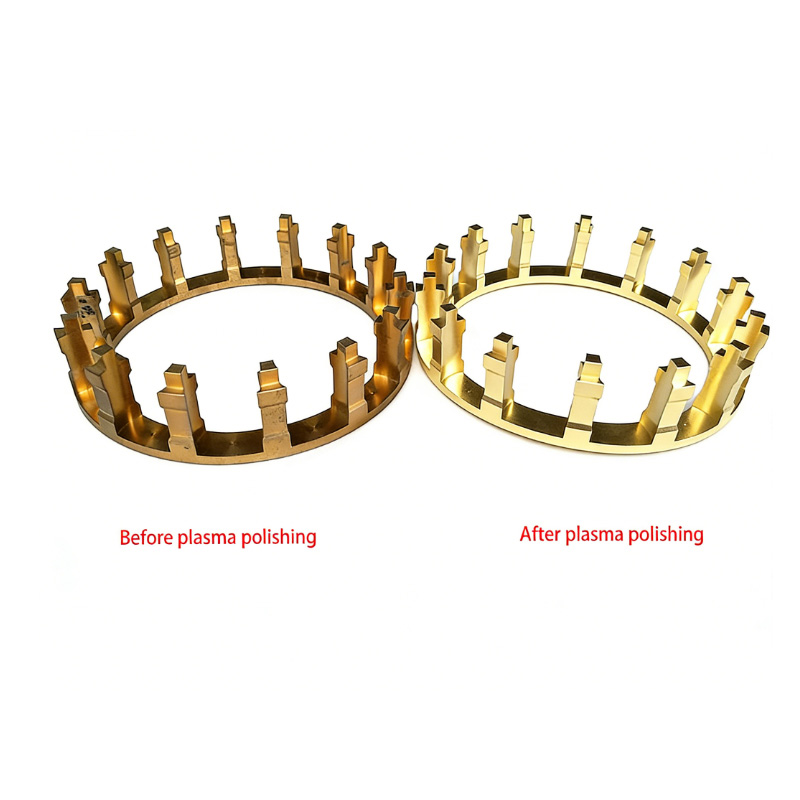
3. A Dual-Scale Revolution: Macro vs. Micro Surface Transformation
One of the most overlooked advantages of plasma polishing is its ability to simultaneously influence both macro geometry and microstructure. Traditional finishing methods often force manufacturers to choose: improve appearance or preserve structure. Plasma changes that equation.
At the macro level, visible features such as edges, holes, and contours become smoother and more uniform. At the micro level, the surface undergoes a subtle but powerful reorganization—peaks are dissolved, valleys are leveled, and randomness is replaced by uniformity.
This dual-scale transformation is what makes plasma polishing technology uniquely suited for high-precision industries.
4. Microstructural Evolution: From Chaos to Order
Every machined surface, no matter how precise, contains microscopic imperfections—tool marks, scratches, and deformation layers caused by cutting or grinding.
With plasma polish, these irregularities are not simply covered—they are systematically removed through controlled ion interaction.
The result is a surface that is:
● Significantly lower roughness
● Highly uniform and isotropic
● Free from mechanical stress layers
Unlike grinding or buffing, this process does not introduce new defects. Instead, it restores structural consistency at the microscopic level.
5. Edge Intelligence: How Plasma Reshapes Corners and Burrs
Edges are the most vulnerable—and often the most problematic—areas in precision components. Sharp corners can cause stress concentration, safety risks, and poor sealing performance.
A plasma polishing machine naturally targets these high-energy regions. Sharp edges and burrs experience faster material removal due to their higher surface energy.
This leads to:
● Smooth, rounded edges
● Complete burr removal
● Improved assembly safety
This “intelligent rounding” happens without compromising overall geometry—something extremely difficult to achieve with manual or mechanical deburring.
6. Surface Chemistry & Performance Upgrades
Beyond geometry, plasma polishing technology also alters the chemical and physical properties of the surface.
During the process, a thin passive layer can form, especially on stainless steel and similar alloys. This layer enhances corrosion resistance and reduces oxidation.
Additionally, the densified surface structure:
● Reduced impurity adhesion
● Improved cleanability
● Better anti-fingerprint performance
This makes plasma-polished components ideal for medical, food-grade, and high-end electronic applications.
7. Dimensional Integrity: Precision Without Compromise
A common concern among engineers is whether polishing will alter critical dimensions.
With plasma polishing, material removal occurs at the micron level and is highly uniform.
This means:
● Minimal dimensional reduction
● Predictable and controllable removal
● No impact on tolerances or fit
For high-precision industries, this balance between surface improvement and dimensional stability is critical.
8. Plasma Polishing vs. Conventional Polishing Methods
When comparing plasma polishing with traditional techniques, the differences are fundamental rather than incremental.
● Mechanical Polishing
● Fast but introduces scratches and stress
● Chemical Polishing
● Simple but difficult to control
● Electropolishing
● Good finish but limited uniformity
● Plasma Polishing
● Uniform, stress-free, and highly controllable
This is why forward-thinking polishing machine manufacturers are positioning plasma systems as premium solutions.
9. Industry Applications: Where Surface Perfection Matters Most
The impact of plasma polishing technology is most evident in industries where surface quality directly affects performance.
● Aerospace: Reduce fatigue points and improve reliability
● Medical Devices: Ensure biocompatibility and hygiene
● Electronics: Enhance conductivity and precision
● Precision Manufacturing: Improve fit and lifespan
10. Choosing the Right Partner: Polishing Machine Manufacturer & Factory
Selecting the right polishing machine manufacturer is just as important as choosing the technology itself.
Key factors include:
● Technical expertise in plasma systems
● Customization capability
● After-sales support
● Proven case studies
A reliable polishing machine factory will not only provide equipment but also process optimization support.
11. Conclusion: Redefining Surface Perfection
Plasma polishing is not just another finishing method—it is a paradigm shift in how we think about material surfaces.
By simultaneously refining microstructure, optimizing macro geometry, and enhancing surface chemistry, it delivers a level of performance that traditional methods cannot match.
For manufacturers aiming at high-end markets, investing in advanced plasma polishing machines and partnering with experienced polishing machine manufacturers is a strategic move toward the future.