

1. Introduction: The Surface Finish Challenge in Aerospace Manufacturing
In aerospace manufacturing, surface finishing is not just about aesthetics—it directly impacts performance, safety, and lifecycle reliability. From turbine blades to hydraulic valve components, even microscopic surface imperfections can lead to fatigue failure, fluid inefficiencies, or corrosion risks.
Traditional polishing processes often struggle to meet the stringent demands of aerospace precision parts, especially when dealing with complex geometries and advanced materials. This is where plasma polishing technology begins to redefine industry standards.
2. What is Plasma Polishing Technology?
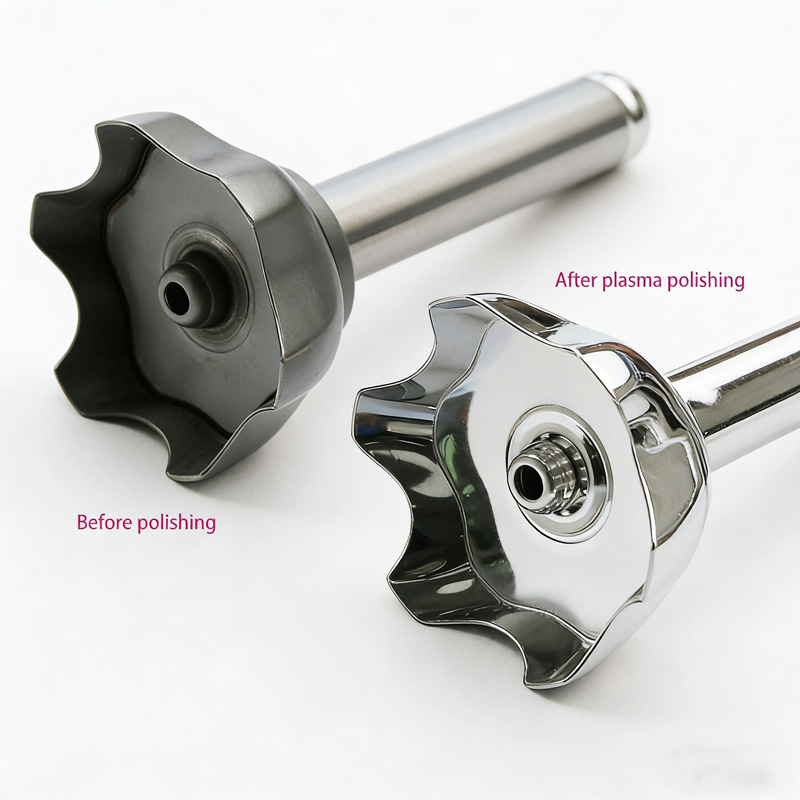
Plasma polishing is an advanced electrochemical surface finishing process that removes microscopic irregularities through controlled ionized energy. Unlike mechanical abrasion, a plasma polishing machine operates without physical contact, enabling uniform material removal at the micron level.
The process forms a plasma layer around the workpiece, selectively dissolving surface peaks while preserving dimensional integrity. This makes it especially suitable for high-precision industries such as aerospace, medical, and semiconductor manufacturing.
3. Aerospace Materials vs. Traditional Polishing Limitations
Aerospace components are commonly made from titanium alloys, nickel-based superalloys, and stainless steel—materials known for their strength, heat resistance, and machining difficulty.
Traditional polishing methods, such as mechanical buffing or grinding, often introduce stress, heat-affected zones, or inconsistent finishes. These drawbacks can compromise the integrity of aerospace parts, especially those with thin walls or intricate internal channels.
4. Why Plasma Polishing is a Game-Changer for Aerospace Precision Parts
4.1 Stress-Free Surface Finishing
Unlike traditional methods, plasma polish is a non-contact process that eliminates mechanical stress and deformation risks. This is critical for aerospace parts where structural integrity must remain uncompromised.
4.2 Micro-Level Surface Perfection
Plasma polishing significantly reduces surface roughness, achieving near-mirror finishes that improve aerodynamic and fluid efficiency while enhancing fatigue resistance.
4.3 Complex Geometry Capability
One of the biggest advantages of plasma polishing technology is its ability to uniformly process internal channels, cross holes, and intricate geometries without blind spots.
4.4 Controllable Material Removal
A key advantage of a modern plasma polishing machine is its ability to precisely control material removal at the micron level. This ensures that aerospace components maintain tight tolerances while achieving superior surface quality.
Such consistency is essential for interchangeable aerospace parts, where even minimal dimensional deviation can lead to system inefficiencies or failure.
4.5 Ultra-Clean Surface Results
Unlike abrasive-based processes, plasma polishing leaves no residual media, oil contamination, or embedded particles. The result is an ultra-clean surface ideal for aerospace systems that demand strict cleanliness standards, such as fuel systems and hydraulic assemblies.
4.6 Compatibility with Difficult Materials
Materials like titanium alloys and nickel-based superalloys are notoriously difficult to polish using traditional methods. However, plasma polish can process these materials efficiently without creating heat-affected zones or metallurgical damage.
5. Plasma Polish vs. Other Finishing Technologies
When evaluating surface finishing solutions for aerospace precision parts, it is essential to compare plasma polish with other commonly used technologies, including mechanical polishing, electropolishing, and chemical polishing. Each method has its own advantages, but also clear limitations when applied to high-performance aerospace components.
Mechanical polishing relies on abrasive contact to remove material. While it is widely used, it often introduces surface stress, micro-scratches, and inconsistent finishes, especially on complex geometries or thin-wall parts. This can negatively impact fatigue life and dimensional stability.
Electropolishing, on the other hand, offers smoother surfaces through electrochemical dissolution. However, its effectiveness is limited when dealing with intricate internal structures such as deep holes or cross channels, where current distribution becomes uneven. Similarly, chemical polishing can achieve uniform treatment but carries risks of over-etching, surface pitting, and chemical residue contamination.
In contrast, plasma polishing technology combines the advantages of electrochemical processes with enhanced control and uniformity. A modern plasma polishing machine enables non-contact, stress-free finishing with precise material removal, even in highly complex geometries. It delivers superior surface integrity, higher cleanliness, and better repeatability.
For aerospace manufacturers seeking both performance and reliability, plasma polishing represents a more advanced and future-oriented solution compared to traditional finishing methods.
6. Key Aerospace Applications of Plasma Polishing Technology
Plasma polishing is widely used in aerospace for:
● Turbine blades and engine components
● Fuel injection systems
● Hydraulic valve bodies
● Precision connectors and housings
● Additive manufacturing (3D printed metal parts)
Its ability to improve both surface integrity and functional performance makes it indispensable in high-end aerospace manufacturing.
7. Conclusion: Is Plasma Polishing the Best Choice for Aerospace?
In conclusion, plasma polishing is not just suitable for aerospace precision parts—it is rapidly becoming a benchmark finishing process for next-generation manufacturing. As aerospace components evolve toward lighter structures, more complex geometries, and higher performance requirements, traditional finishing methods are increasingly unable to meet industry expectations. In contrast, plasma polishing technology provides a unique combination of precision, consistency, and cleanliness that aligns perfectly with the stringent standards of aerospace engineering.
A modern plasma polishing machine enables manufacturers to achieve micron-level surface refinement without introducing stress, deformation, or contamination. This is particularly critical for components such as turbine blades, fuel systems, and hydraulic parts, where even the smallest imperfection can compromise performance or safety. Furthermore, its ability to process difficult materials like titanium alloys and superalloys makes it an indispensable solution in advanced aerospace applications.
From a strategic perspective, investing in plasma polishing is not just about improving surface quality—it is about enhancing overall product reliability, reducing long-term maintenance costs, and gaining a competitive advantage in high-end manufacturing. Working with an experienced polishing machine manufacturer, especially a high-quality China polishing machine supplier, can further optimize cost-efficiency while ensuring technological reliability.
Ultimately, for aerospace manufacturers aiming to meet the highest standards of precision, durability, and consistency, plasma polishing is no longer optional—it is a forward-looking, performance-driven choice.