

In high-precision manufacturing, the final quality of a component is often determined by what happens at the microscopic level. Among these challenges, internal burrs in intricate cross-drilled holes, blind holes, and threaded channels pose a significant threat to product reliability. A standard deburring machine designed for external surfaces simply cannot reach these complex interior geometries. Traditional manual scraping, wire brushing, or CNC mechanical tooling often fail to deliver consistency, leaving behind hidden particles that can cause catastrophic hydraulic failures or blocked fuel lines. As industries push toward micro-miniaturization, manufacturers require a revolutionary automated solution to eliminate internal defects without altering critical tolerances.
What is an Internal Hole Plasma Deburring Machine?
To solve the complex challenge of internal finishing, leading deburring machine manufacturers have developed a highly specialized niche within plasma polishing equipment: the internal hole plasma deburring machine. Pioneered by industry experts like Bayi, these systems are not merely cutting tools; they are advanced electrochemical systems that utilize plasma polishing technology to achieve simultaneous metal polishing and precision deburring.
Instead of relying on physical force or mechanical abrasive heads that must physically enter the cavity, this technology uses an advanced eco-friendly electrolyte bath to wrap the entire workpiece in a uniform energy field. It targets deep holes, intersecting oil lines, micro-apertures, and curved tubes from the inside out, making it the definitive dedicated equipment for hydraulic valves, bushings, nozzles, and aerospace fluid components.
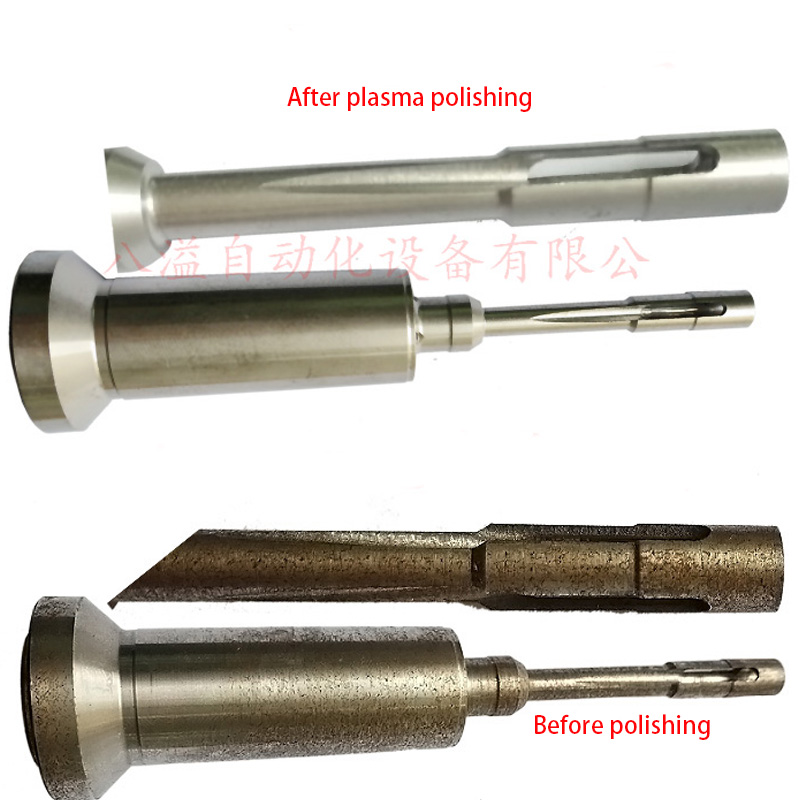
The Science Behind the Finish: Core Working Principle
The exceptional capability of this system lies in its unique electrochemical plasma physics. The process is engineered to isolate and eliminate burrs through the following steps:
1. Electrode Electrification: The metal workpiece is completely submerged in a neutral electrolyte solution and connected to the positive anode, while the internal tank wall serves as the cathode.
2. Plasma Gas Film Formation: Upon activation, a stable, micro-thickness plasma gas film is generated simultaneously across the entire surface of the workpiece, completely coating both the external profile and the internal walls of all interconnected holes.
3. Targeted Disruption: Internal hole exits, cross-hole intersections, and thread burrs act as microscopic sharp corners. According to electrodynamics, the electric field lines heavily concentrate at these sharp peaks.
4. Micro-Etching: This intense concentration causes the dissolution and corrosion rate at the burr to be exponentially higher than that of the flat hole wall. The burr is dissolved at a micron level ($1\text{--}6\,\mu\text{m}$ removal rate), meaning only the unwanted flash is targeted, leaving the reference inner diameter completely unaltered.
Why Choose Plasma Over Traditional Metal Deburring Machines?
When compared to a standard mechanical metal deburring machine, the internal hole plasma finishing system offers unparalleled operational advantages that optimize production lines.
| Feature / Advantage | Traditional Mechanical Methods (Brushes, CNC, Robots) | Internal Hole Plasma Polishing & Deburring |
| Cross-Hole Capability | Blind spots present; cannot clean complex internal intersections. | $360^\circ$ full-field coverage; zero processing blind spots. |
| Dimensional Integrity | High risk of scratching inner bores or enlarging hole tolerances. | Controlled $1\text{--}6\,\mu\text{m}$ removal; preserves master dimensions. |
| Thin-Wall Safety | Mechanical pressure causes deformation, burr collapse, or edge chipping. | Zero mechanical friction; safe for thin-walled parts ($\sim 0.2\,\text{mm}$). |
| Micro-Hole Processing | Limited by tool size; impossible under $\phi 1.0\,\text{mm}$. | Capable of processing micro-apertures down to $\phi 0.5\,\text{mm}$. |
| Process Integration | Requires separate deburring, degreasing, and polishing stages. | Combines deburring, oil/oxide removal, and polishing into one step. |
Through this process consolidation, manufacturing operations can eliminate multiple manual buffing and ultrasonic washing steps, drastically lowering labor costs while ensuring absolute batch consistency across thousands of parts.
Choosing the Right Partner: Sourcing from a World-Class Deburring Machine Factory
Investing in technology is only half the battle; acquiring a turn-key solution requires partnering with a certified deburring machine factory that understands the nuances of material chemistry. A true manufacturing partner does not just sell standard machinery. They provide a total solution tailored to your production ecosystem, which includes:
1. Custom Electrolyte Formulation: Tailoring the neutral salt formula to match your specific alloy (e.g., stainless steel, brass, titanium) to guarantee rapid plasma gas film activation.
2. Customized Fixturing: Engineering specialized anodized tooling to secure components and optimize internal electric field distribution.
3.Automation Integration: Merging the plasma unit with robotic arms and automatic rinsing stages for a hands-free, high-throughput manufacturing line.
When vetting global suppliers, ensure your selected manufacturer offers comprehensive process testing on your actual parts before shipment to prove dimensional safety.