

1. Introduction: Manufacturing Challenges Beyond Burrs
In modern precision manufacturing, surface quality impacts product performance, assembly accuracy, and operational safety. Burrs and rough edges are often underestimated, but they can lead to assembly issues, reduced component life, and even product recalls. For example, in aerospace manufacturing, a minor burr on a turbine blade can affect airflow, causing efficiency loss and safety hazards.
A deburring polishing machine, particularly a plasma-based deburring and polishing machine, addresses these challenges by providing a repeatable, precise, and automated solution. Unlike manual or mechanical methods, it ensures uniform surface finishing across hundreds or thousands of parts, significantly reducing manufacturing risks.
2. Why Traditional Deburring and Polishing Methods Fall Short
Traditional deburring and polishing methods, including manual scraping, mechanical tumbling, and chemical polishing, are limited in several ways:
① Manual Deburring: Relies on operator skill, inconsistent results, fatigue issues, and high labor costs.
② Mechanical Polishing: Can damage delicate parts, introduces tool wear, and is less precise on complex geometries.
③ Chemical Polishing: Raises environmental concerns, produces wastewater, and requires regulatory compliance.
For high-volume or high-precision manufacturing, these methods often fail to provide the repeatability and quality control required. For instance, an electronics manufacturer reported a 15% defect rate on connector components processed manually. By switching to a plasma-based deburring and polishing machine, defect rates dropped to under 2%, and cycle times decreased by 20%.
3. Plasma Polishing Technology: Micro-Level Precision
Plasma polishing removes burrs at a micro and nano level using controlled electrochemical reactions. Unlike grinding or abrasive methods, plasma polishing does not physically stress the part, preserving dimensions and complex geometry. Key advantages include:
● Non-contact finishing: Reduces mechanical stress and avoids micro-scratches.
● Precision material removal: Achieves surface roughness Ra ≤ 0.2 µm for high-precision applications.
● Complex geometry handling: Capable of internal cavities, fine threads, and delicate components.
A case study in aerospace precision parts showed that using a plasma deburring polishing machine, internal cavities of titanium brackets achieved uniform surface quality, which was impossible with traditional tumbling methods.
4. How Plasma Deburring Polishing Machines Improve Manufacturing Logic
Plasma deburring polishing machines shift focus from speed to process uniformity and part integrity. Each part is subjected to the same electrochemical conditions, reducing human error and variability. Key impacts:
● Higher yield: Consistent surface finish reduces rework and scrap.
● Labor efficiency: Automated processing reduces dependency on skilled operators.
● Predictable cycle times: Easier production planning and workflow management.
Example: A medical device manufacturer processing stainless steel surgical instruments reduced scrap by 30% and saved 40% on manual labor by implementing a plasma system.

5. Key Advantages of Plasma Deburring and Polishing Machines
① High Precision: Maintains part geometry while removing burrs.
② Repeatability: Every part achieves identical surface finish.
③ Automation-Friendly: Reduces dependency on operator skill.
④ Eco-Friendly: Minimal chemical use, reduced wastewater, lower energy consumption.
⑤ Material Versatility: Stainless steel, aluminum, titanium, copper alloys, and precious metals.
⑥ Complex Part Capability: Handles internal cavities, thin walls, and micro-components.
⑦ Cost Efficiency: Reduces scrap, rework, and long-term labor costs.
Case Study: A jewelry manufacturer using a plasma deburring polishing machine reduced polishing time per component by 50%, while achieving a mirror-like finish consistently.
6. Environmental Benefits
Plasma polishing significantly reduces chemical consumption, wastewater, and energy compared to chemical polishing. This aligns with stricter environmental regulations and sustainability goals. Companies report up to 20% energy savings and compliance with ISO 14001 standards when switching to plasma systems.
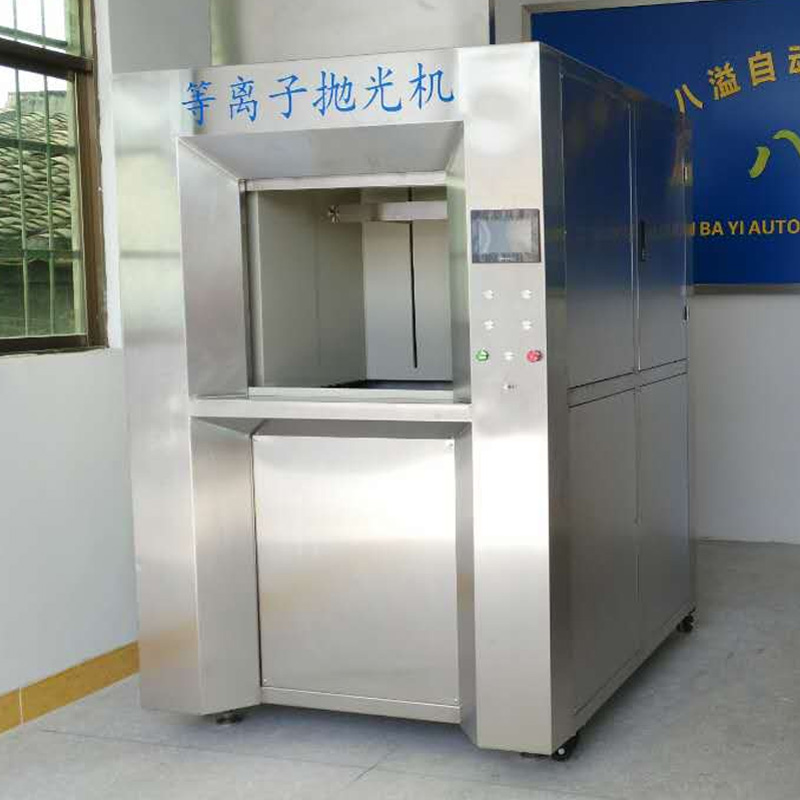
7. Choosing the Right Machine: Strategic Considerations
Factors to consider:
● Part Size and Geometry: Larger or complex components may require higher-capacity machines.
● Material Type: Ensure compatibility with stainless steel, aluminum, titanium, or copper alloys.
● Production Volume: Continuous or batch production affects machine selection.
● Automation Level: Fully automated vs semi-automated depends on labor and workflow.
● Environmental Compliance: Machines with minimal chemical use may be prioritized.
FAQ
Q1: Can plasma polishing handle complex-shaped parts?
A: Yes, plasma technology excels in intricate geometries, internal cavities, and thin-walled components.
Q2: Is plasma deburring environmentally friendly?
A: Yes, it uses fewer chemicals, produces less wastewater, and reduces energy consumption.
Q3: Which industries benefit most from plasma deburring polishing machines?
A: Medical devices, aerospace, electronics, jewelry, automotive, and precision hardware.