

Introduction — Why rough edges still cost manufacturers time and money
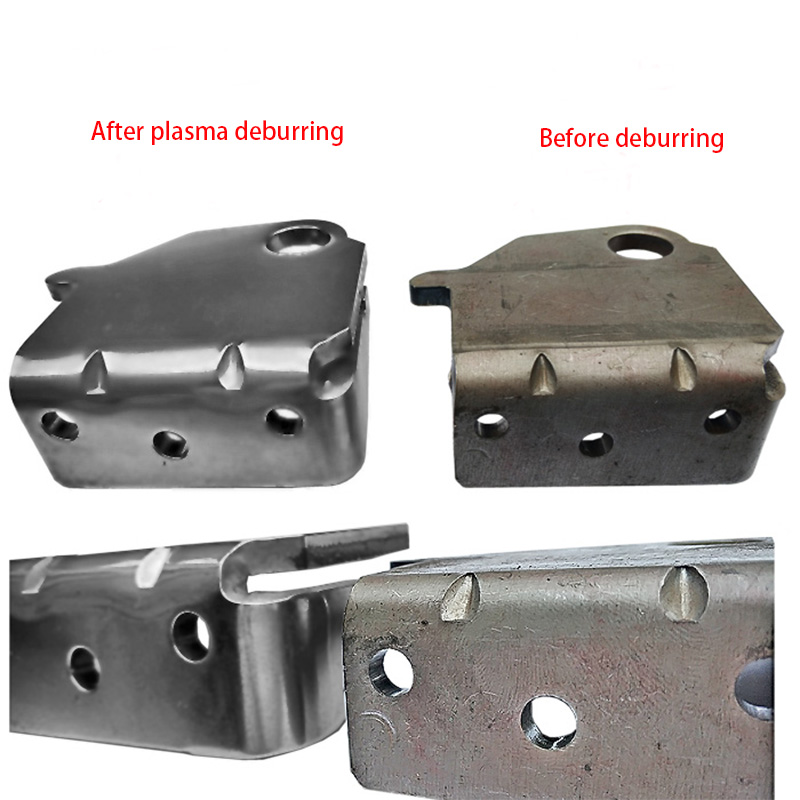
Burrs, slag, and sharp edges are more than cosmetic problems — they cause assembly issues, increase rework, create safety risks, and reduce product lifespan. Traditional manual grinding, polishing, or chemical deburring are slow, inconsistent, or environmentally unfriendly. Enter plasma deburring: a fast, clean, automated method that removes burrs and polishes edges on metals like stainless steel, aluminum, and copper while preserving part geometry and tolerances.
What is plasma deburring and how does it work?
Plasma deburring uses a focused, high-energy plasma arc to vaporize burrs and smooth edges without mechanical contact. Unlike abrasive methods, plasma works by controlled thermal processing — it melts, vaporizes, or oxidizes unwanted protrusions while leaving the base geometry intact. Modern systems combine CNC motion, programmable parameters, and gas control to deliver repeatable finishes on complex parts.
Top benefits of choosing Bayi’s plasma deburring technology
- Consistent surface quality: Programmable cycles produce uniform edge radii and finishes across batches.
- High throughput: Single-pass processing reduces cycle time versus manual polishing.
- Material versatility: Effective on stainless steel, aluminum, copper, titanium and alloys.
- Minimal fixture contact: Reduces risk of mechanical distortion for thin or delicate parts.
- Cleaner & greener: No chemical baths, reduced consumables, and lower waste generation.
- Labor savings: Automating finishing reduces dependence on skilled hand finishing and the associated labor cost variability.
- Safety improvements: Removes sharp edges that can cause employee injuries during assembly.
Bayi vs. traditional deburring — a practical comparison
-
Manual grinding/polishing: Low capital cost but high labor, inconsistent results, hard to scale.
-
Media tumbling: Good for simple parts in bulk but poor for assemblies, internal bores, or tight tolerances.
-
Chemical deburring: Effective for complex geometries but involves hazardous waste, long cycle times, and regulatory overhead.
-
Plasma deburring (Bayi): Fast, programmable, environmentally friendly, and suitable for precision parts and assemblies.
Typical applications
-
Medical device components (stainless steel instruments, implants)
-
Aerospace brackets, fittings, and precision hardware
-
Automotive parts and small powertrain components
-
Consumer electronics housings and frames
-
Custom fabricated stainless steel parts (kitchenware, hardware)
Quick buyer’s checklist — choosing the right plasma deburring machine
-
Part size & throughput needs: table size, cycle time per part, and batch volume.
-
Material compatibility: confirm capability for your alloys and thickness ranges.
-
Automation & integration: PLC/CNC, robot compatibility, conveyor or pallet systems.
-
Control features: programmable recipes, multi-axis motion, vision guidance if required.
-
Edge finish specs: required surface roughness (Ra), edge radius, and tolerances.
-
Footprint & utilities: power, gas supply (if needed), exhaust and ventilation.
-
After-sales support: on-site commissioning, training, spare parts, and remote diagnostics.
-
ROI estimate: labor saved, reduced rework, faster cycle times, lower waste disposal costs.
How to get the best results — Bayi’s recommended operating tips
-
Use pre-defined process recipes matched to material and burr type.
-
Combine plasma with minor mechanical finishing only when specified finish levels require it.
-
Keep a log of cycle parameters and part outcomes to quickly scale or reproduce quality.
-
Schedule basic preventive maintenance on torch consumables and filtration to preserve consistency.
-
Train operators on fixturing: consistent part orientation and stable clamping ensure repeatable finishes.
Real-world ROI — what customers typically see
Manufacturers switching to Bayi plasma deburring machines often report:
-
30–70% reduction in finishing labor costs
-
50% or more reduction in cycle time for small/complex parts
-
Significant reduction in rework and scrap rates
(Your exact ROI will vary by part complexity, prior process, and volumes — Bayi offers free ROI assessments.)
FAQ
Q: Will plasma deburring distort thin stainless parts?
A: Properly programmed plasma cycles and optimized fixturing eliminate most thermal distortion risks. Bayi systems include process recipes and fixturing guidelines for thin sections.
Q: Is plasma suitable for internal bores and hidden burrs?
A: Plasma is ideal for exposed edges, and with specialized torches and fixturing can handle many internal features. For extremely confined geometries, consider hybrid processes.
Q: What maintenance is required?
A: Replace consumable tips as recommended, keep filtration systems clean, and schedule periodic calibration. Bayi provides service plans to simplify upkeep.
Call to action
Ready to eliminate rough edges and boost your finishing throughput? Contact Bayi today for a free process evaluation, sample part testing, and ROI estimate.